Showing posts with label Bibliographies. Show all posts

Monday, April 21, 2025

Take a Hike! - Kids' Books About National Parks


Happy Earth Day and National Parks Week!

Another bibliography inspired by my recent travels. In the last few years I've gotten into hiking, which then led to visiting & exploring national parks. The National Park Service has reported record numbers of visitors in the last few years, so clearly I'm not the only one! This bibliography includes fictional stories as well as non-fiction informational books about the parks, their histories, and the people who helped create and take care of them.

Fiction
*Highly Recommended Series!*
National Park Mystery
series
by Aaron Johnson
Currently 5 books of a planned 10-book series
Self-published, 2022+
260-346 pages, a few illustrations
Ages 9-14

This mystery-adventure series is one of those rare unicorns - self-published books that are really good! I am personally really enjoying this series and *highly* recommend it. This series follows Jake, his cousin Wes, and friend Amber (along with their parents) on a road trip visiting 10 national parks and completing a scavenger hunt planned by his late grandfather. However, what Jake thought was a simple scavenger hunt for fun turns out to be far more important, with precious artifacts to protect, villains to outwit, and ties to one of Jake's ancestors.

This series is well-written, and includes descriptions of several sites and trails in each park, along with clues, puzzles, and secret codes to solve. There are also lessons in teamwork, safety, frienship, and dealing with fears and strong emotions. There is also a story-within-the story set in the past that makes it all the more interesting. Each book in the series begins with a short recap of what has happened in the previous books, and there is factual information and discussion at the end. The books are best read in order. The author's website has a few free resources for teachers, an online scavenger hunt, and bookmarks with codes to solve, a coloring book, and other items to purchase. The parks covered so far are: Rocky Mountain, Great Sand Dunes, Grand Canyon, Zion, and Yosemite. The next five books will take place in Mount Rainier, Olympic, Glacier, Yellowstone, and Grand Tetons.


*Series For Younger Readers*
The Campground Kids
series
by C. J. Fulton
Currently 12 books in the series
Bakken Books, 2022+
170-200 pages, very few illustrations
Ages 7-10

Another mystery-adventure series following Isaiah, his sister Sadie, their parents, and cousin Ethan as they visit various national parks, encountering challenges from nature as well as man-made mysteries. This series is more for younger readers as they are short with simple, linear plots. The writing could be better; the moralistic lessons are rather heavy-handed, the characters don't feel authentic at times, and there are some potentially problematic characterizations, such as referring to a senior citizen as "ancient". In my opinion, the quality of this series is nowhere near that of The National Park Mystery series, but it is also aiming for a younger demographic and still worth reading for those who aren't ready for something longer and more complex. Books do not necessarily have to be read in order; though they occasionally refer to previous events, the stories stand alone. The parks covered thus far are: Grand Tetons, Smoky Mountains, Zion, Rocky Mountains, Grand Canyon, Yellowstone, Yosemite, Acadia, Glacier, Arches, Olympic, and Joshua Tree.


Where the Sky Lives
 by Margaret Dilloway
HarperCollins, 2022
336 pages
Ages 9-12

Tuesday lives in Zion National Park where her mother is the park archaeologist, and where her late uncle taught her astronomy. But now a new development is threatening the dark sky stargazing at Zion, as well as the habitat of an endangered animal. This story deals with loss and grief, mother-daughter relationships, science, and environmentalism, all set against the backdrop of Zion National Park.


Camp Time In California
 by Mary Pope Osborne
#35 in the Magic Treehouse series
Random House, 2021
112 pages
Ages 6-9

Jack and Annie's latest magical adventure takes them to Yosemite National Park to save the wilderness! A beloved modern classic beginning chapter book series for transitional readers.

*Available in Prose or Graphic Formats*
I Survived the Attack of the Grizzlies, 1967
 
by Lauren Tarshis
#17 in the I Survived series/#5 in I Survived graphix series
Random House, 2018/Graphix, 2022
144 pages/160 pages
Ages 8-11

This installment from another beloved transitional series tells a fictionalized story of the 1967 grizzly bear attacks in Glacier National Park, from the point of view of fictional 11-year old Melody Vega. In real life, these attacks led to many changes in policy and management of national parks to reduce human-bear interactions and prevent future attacks. Also available in graphic format.


The Growling Bear Mystery
 
#61 in The Boxcar Children series created by Gertrude Warner
Random House, 1997
128 pages
Ages 7-10

In this installment of the popular Boxcar Children mystery series the Alden's are on a treasure hunt in Yellowstone National Park, searching for the legendary lost gold of the Lost Miner's Cabin. However, it seems that someone doesn't want them to find it, and all are not as they seem!


*Picturebook*
Travel Guide for Monsters
 by Lori Degman & Steve Szalay
Sleeping Bear Press, 2020
32 pages, illustrated
Ages 3-6

Just on the off chance you were planning to take a monster with you on your road trip across America, you should read this book! Little kids will love this humorous book with travel tips for accompanying monsters, which includes visits to several national parks, as well as various cities, historical sites, landmarks, and other sites of interest.

Encyclopedias & Atlases 
These are good if you are interested in learning a little about multiple or all parks, and may be the only books with info on some of the lesser-known parks. For more info about specific parks, try the series non-fiction below.

*Tried & True*
Eyewitness National Parks
 by DK
DK/Penguin Random House, 2023 
72 pages
Ages 8-12

This classic packs a lot of information in in a small space, though some of the less popular parks are relegated to half a page. One thing that I really like about this book is that it includes a small map of each park; they aren't detailed, but a really nice addition that none of the other encylopedias have. One thing I really don't like is that there doesn't seem to be a logical order, maybe roughly east to west?? At least there is an index and all 63 parks are represented.


*All 63 National Parks*
The National Parks Encyclopedia
 by Allison Lassieur
Abdo Books, 2023
192 pages
Ages 8-12

One of the more recent publications, this encyclopedia includes all 63 National Parks, with 2-4 pages of photos and highlights for each. It is a smaller format than other encyclopedias, so photos are smaller and fewer, and may not have as much information as others, but it has an attractive, modern aesthetic.


*Good Info & Photos, Confusing Order*
The National Parks
 by Stefanie Payne
DK/Random House, 2020
128 pages
Ages 8 and up

This book is fairly recent, but it is missing the newest national park, New River Gorge in West Virginia, which was designated a national park at the end of 2020. The first spread is a general introduction to national parks, followed by nice map of the U.S. showing the locations of all of the national parks, with size of the park indicated, and color-coded by the type of habitat. That is followed by 1-2 pages for each park, with a few interesting facts, photos, and illustrations with a few full-spread photos for selected parks. The one thing I *really* didn't like is the parks seem to be listed randomly, with no rhyme or reason that I could figure out; they are not listed alphabetically, chronologically, or geographically. Fortunately, there is an index at least. The book finishes with a few tips for wildlife spotting and a glossary.


*A Mix of National Parks & Other Landmarks*
National Parks: A Kid's Guide to America's Parks, Monuments, and Landmarks
by Erin McHugh (author) & Neal Aspinall, Doug Lean, Brian Maebius (illustrators)
Workman Kids, 2019
128 pages
Ages 8-12

I have a bone to pick with the author and publisher for entitling this book "National Parks" when it only includes some of the actual National Parks. However, it does include several other parks, forests, landmarks, monuments, and historical sites that you might also be visiting on your road trip, or be otherwise interested in learning about.


*Artistic Illustrations & Companion Activity Book*
National Parks of the U.S.A. 
by Kate Siber (author) & Chris Turnham (illustrator)
Wide Eyed Books, 2018
112 pages
Ages 8-12

This book is truly a work of art, with illustrations rather than photographs and a lovely embossed cover. The downside is that it only covers 21 of the now 63 national parks. But for the parks it does cover, it packs in a lot of information, particularly about the wildlife, which will appeal to kids. You can also purchase an accompanying activity book with activities, a fold-out poster, and stickers to go with it.


*More Great Sights to See*
National Monuments of the U.S.A.
by Cameron Walker (author) & Chris Turnham (illustrator)
Wide Eyed Books, 2023
112 pages
Ages 8-12

A companion to the book of national parks above, this book features a wide variety of national monuments, some natural and some man-made, including the Statue of Liberty, the National Mall, Dinosaur Monument, Devils Tower, and many more. Beautifully illustrated with an embossed cloth cover. A great complement to any National Park encyclopedia. There is also a companion activity book available, with more than 25 activities, a fold-out poster, and 30 stickers.


*Fun Scavenger Hunt*
The National Parks Scavenger Hunt
 by Stacy Tornio
Timber Press, 2023
236 pages
Ages 5-11

This book turns exploring national parks into a fun scavenger hunt with items to find or activities to do at each park to score points. All 63 national parks included.

*Best Atlas*
Atlas of the National Parks
 by Jon Waterman
National Geographic, 2019
432 pages
Ages 12 and up

Ok, this is not a kids' book, but is far superior to the children's atlas below. I would skip the kids' maps and use this one. Because it was published in 2019, it is missing the two most recent National Parks, the Gateway Arch in St. Louis, and New River Gorge in West Virginia.


*Disappointing*
National Parks Maps
by Abby Leighton
Gibbs Smith Books, 2021
80 pages
Ages 6-12

I was so excited when I first came across this title, but was very disappointed after I got my hands on a physical copy. I really question the artistic choice to represent the maps in such a cartoon-y graphic style with fonts and color-schemes that make them very hard to get much useful information from them, especially with some of the color choices. Some are better than others, but overall such a missed opportunity in my opinion, though reader reviews on Amazon are much more favorable, so it may just be a matter of aesthetics and personal preference. 


National Park History & General Info

*Graphic Novel*
The National Parks: Preserving America's Wild Places
by Falynn Koch
First Second/Roaring Books Press, 2022
128 pages
Ages 9-13

Part of the publisher's History Comics series and narrated by Sasquatch, this book tells the story of how the concept of national parks and the resulting National Park service developed. As Sasquatch explains it to his bald eagle friend, readers will learn about the process of how national parks are designated, other types of federal parks and lands, and how parks may lose national park designation. This book is not so much the history of specific parks (though some are touched on) but of the idea of national parks as a whole. The author has served in the national park service as both a park ranger at various parks, monuments, and historic sites as well as an administrator. (Readers may also be interested in The American Bison: The Buffalo's Survival Tale by Andy Hirsch from the same series.)


*Picturebook*
The Camping Trip That Changed America
by Barb Rosenstock and Mordicai Gerstein
Dial Books for Young Readers, 2012
32 pages
Ages 6-10

This non-fiction picturebook tells of the camping experience with John Muir that inspired President Theodore Roosevelt to lead the development of legislation to protect wilderness areas and wildlife, leading to the creation of national parks, forests, wilderness areas, and wildlife sactuaries and today's National Park Service. 


50 True Tales from Our Great National Parks
by Stephanie Pearson (author) & Madeline Kloepper (illustrator)
Wide Eyed Editions, 2024
128 pages
Ages 7-12

A collection of 50 short stories. Some tell of historical events, others about an interesting plant or animal, how parks were formed, and a few are folklore. Interesting, but the stories are a bit too short, in my opinion, and leave the reader wanting to know more. Good supplement to an encyclopedia or other non-fiction.


*Graphic Novel*
Major Impossible
 
by Nathan Hale
#9 of Nathan Hale's Hazardous Tales series
Amuelt Books, 2019
128 pages
Ages 8-12

People are divided on whether books in this graphic series are historical fiction or non-fiction; I'm leaning toward historical fiction, based on factual events. With a limited color palette, this graphic novel tells of Civil War veteran and explorer John Wesley Powell's harrowing expedition to ride the Colorado River through the Grand Canyon in 1869, long before it was a National Park. Powell is portrayed as a heroic explorer in this story, but in real life Powell's legacy as a man who "never saw a river he didn't want to dam" is more complex.


*Picturebook*
If I Were a Park Ranger
 
by Catherin Stier & Patrick Corrigan
Albert Whitman & Co., 2022
32 pages
Ages 3-6

A non-fiction picturebook that introduces children to an often under-appreciated and under-represented occupation. Children will learn a litte about what a park ranger does and how they help make state and national parks more accessible and enjoyable for us all.


*Boardbook*
B is for Bison
 by Greg Paprocki
Babylit, 2021
32 pages
Ages 0-5

This cute little alphabet boardbook features wildlife and scenery from 26 different national parks. Readers may also be interested in C is for Camping by the same author. There are actually a surprising number of national-park themed boardbooks available; too many to include here, but easy enough to find if you search online.

Series Non-Fiction
For more detailed information on selected national parks. 

*Most Recent*
U.S. National Parks series by Bellwether Media
Multiple authors & illustrators
Published in 2023 & 2024
32 pages
Interest Level - Grades 3-8
Reading Level - 4th Grade

This is the most recent series to the market and thus should have the most up to date information. The covers are fresh and modern, evoking the classic arrowhead logo of the National Parks. Inside you'll find lots of info-bites about the park: where it is, the geography, how it was formed, wildlife, plants, things to do and see, human impact, stats, timeline, food web, glossary, index, and a few suggested books and websites for more information. It is heavily illustrated with beautiful photographs, with a few infographics. This series is perfect for readers who want to get a brief overview of the park and see lots of photographs. Though publisher recommends for grades 3-8, I think younger children would also enjoy sharing it with a caregiver, and 6th grade and up might find it too superficial.

The downside of this series is that as of now, only 12 of the 63 National Parks are included: Acadia, Glacier, Grand Canyon, Great Smoky Mountains, Rocky Mountains, Yellowstone, Yosemite, Zion, Everglades, Grand Tetons, Joshua Tree, and Olympic. It is unclear if more titles will be added.

*Favorite Overall Non-Fiction Series*
"A True Book" National Parks
 series by Scholastic
Multiple authors & illustrators
First published in 1997, latest editions 2018/2019
48 pages
Recommended for ages 3-10

Very similar to the Bellwether series above, with lots of color photos, some infographics and stats, and brief tidbits of info about the park, things to see, things to do, animals, plants, glossary, index, and suggestions for more info. However, this series has several more pages and tells a bit more of the history of the park, and scores major points for including a decent map of the park. I would probably say this I like this series the best of all, with Bellwether's U.S. National Parks a very close second. One downside is that this series is older, so some of the information will be outdated and I'm not sure if it is still in print. Hopefully new, updated editions are coming soon! 

Again, doesn't include every national park, and some that are included are actually national monuments or historical sites rather than official "National Parks". Included parks are: Acadia, Bryce Canyon, Cuyahoga Valley, Death Valley, Everglades, Gettysburg, Glacier, Grand Canyon, Grand Tetons, Great Smoky Mountains, Hawai'i Volcanoes, Joshua Tree, Martin Luther King, Jr. Memorial, Mt. Ranier, Olympic, Rocky Mountains, Yellowstone, Yosemite, and Zion. Also note there is also a Scholastic "Rookie"  national park series for younger readers.

*Best for Older Readers*
Preserving America
 series by Creative Education
Multiple authors & illustrators
2016
48 pages
Recommended for ages 10-14

This series is not for someone who wants quickly-digestible tidbits of information and to be able to flip through a book a quickly get a good "feel" for a place. However, if you need a source for a school report or project or want to do more in-depth reading, this series fits the bill. While these books do have plenty of color photographs, they also have pages of dense text written at a higher reading level. A glossary and index are included, as well as a more detailed map and longer bibliography of books and websites for additional information. 

Note this is an older series, so information may be dated, but it does include some parks not found in other series. Parks included are: Badlands, Big Bend, Death Valley, Everglades, Grand Canyon, Grand Teton, Great Smoky Mountains, Rocky Mountain, Yellowstone, and Yosemite.

*Most Artistic*
Earth's Incredible Places
 series by Flying Eye Books
Multiple authors
2023/2024
80 pages
Recommended for ages 8-12

This series currently includes two U.S. National Parks, Grand Canyon and Yellowstone. These books are absolute works of art, with lovely illustrations throughout, gorgeous endpapers, and beautiful emobssed cloth covers; just beautiful! They would be great for a personal collection, but the covers aren't going to hold up well in a public or school library as they will hold onto dirt and stains and can't be easily cleaned. This series is for the older reader, with more pages and more text per page, and provides more in-depth info about the history, geography, and ecology of the park, and also includes a map, albeit heavily stylized. However, while it gives a general idea of things to do in the park, it doesn't give any specific sites, and though the illustrations are absolutely lovely, they don't give one as good of a "feel" for the park as photographs so best to pair with a book from one of the other series.
*Fold-Out Map*
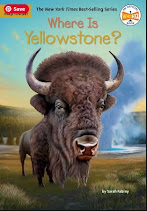
Where Is...
 series by WhoHQ
Multiple authors
Penguin, 2024
Around 100 pages
Ages 10-14

This series also currently only includes two national parks, Yellowstone and the Grand Canyon, and is for older readers who want information and don't care about photographs. Like the original and oh, so popular Who Is/Was...? biography series, this book is written in a more narrative, chapter book format with only black & write drawings. However, it scores points for the color fold-out map, detailed timeline, and bibliography in the back.


These are just some of the books related to national parks that are available. There are several more encyclopedia-type books that I was not able to get copies of to review, as well as a number of boardbooks (though surprisingly almost no picturebooks) and stand-alone books on individual parks. In addition, there are several activity and coloring books that can be purchased online. 

To find more on national parks, try searching for "National Parks" or the name of a specific national park, then narrow your search by fiction or non-fiction, and age group/intended audience. Or ask your local librarian or bookseller for help! You can also check the official websites for each park, or download the official National Park app. Don't forget, there are many other federal parks, forests, wilderness areas, wildlife sactuaries, monuments, and historical sites that are not designated as "National Parks", plus a plethora of state parks and historic sites!


Wednesday, March 19, 2025

UFOs, Aliens, and Flying Saucers - Books About the Roswell Incident for Middle Grade Readers


This fun little bibliography was inspired by a recent trip to New Mexico. The original plan was to fly into El Paso, Texas, and drive a loop to visit three national parks: Guadalupe Mountains, Carlsbad Caverns, and White Sands, but I later decided it would be fun to add a day in Roswell, New Mexico, to see all the kitschy alien stuff as well, and it was! 

Since this little detour was inspired by having recently read a really good middle-grade book with a fictitious story about the Roswell incident, I decided to put together a few other titles of fiction and non-fiction related to the Roswell Incident, flying saucers, and other UFOs. This bibliography would be perfect for those intrigued by UFOs, those who enjoy science fiction, or those who may also be planning a visit to Roswell.

Non-Fiction 

What Do We Know About the Roswell Incident?
Ben Hubbard (author) & Andrew Thompson (illustrator
WhoHQ, Penguin/Random House, 2023, 112 p.
Ages: 8-12

The Roswell Incident and subsequent myths and hoaxes related to it is really too complex of a topic for this series to tackle, and results in a superficial and over-simplified story. While a more simple overview of topics and biographies is the hallmark of the WhoHQ brand and is more appropriate for the intended audience of younger middle-grade readers, in this case it results in a less than clear distinction of fact from fiction that may leave some readers confused about what really happened. 

However, it is one of very few books on the subject for younger readers, and would be ideal for lessons in critical thinking and information literacy, with adult guidance and discussion. Though reportedly for ages 8-12, with its larger font, greater amount of white space, and illustrations, it is more likely to appeal to ages 8-10.

Crash from Outer Space:
Unraveling the Mystery of Flying Saucers, Alien Beings, and Roswell.
Candace Fleming (author)
Scholastic Focus, 2022, 288 p.
Ages 8-12

Fleming does an excellent job of presenting all the various stories, alleged evidence, and the social, political, and technological conditions that led to the development and spread of tales of flying saucers and alien beings that began with the Roswell incident in 1947, and how they have been de-bunked. This book does a much better job of separating fact from fiction that the one above, as to be expected since it is approximately three times as long and written at a higher level. The text is supplemented by numerous photographs to help maintain interest and support the information in the text. Fleming also supplies a lengthy bibliography divided into primary and secondary sources, as well as source notes by chapter and photo/illustration credits.

Due to the length and higher reading level, I would recommend this book for ages 10 and up; it would also be good for teens or adults who are interested in reading an objective, fact-based account of the Roswell Incident and subsequent saucer-mania, hoaxes, and conspiracy theories. Highly recommend! 

Fiction 

Eyes On the Sky
J. Kasper Kramer (author)
Atheneum Books for Young Readers, 2024, 256p.
Ages 8-12

This a story of historical science fiction, set in 1947 outside of Roswell, New Mexico, and has strong themes of family and friendship. And flying saucers! 

Dorothy lives with her older brother on a small ranch outside of the small, decidedly boring town of Roswell where nothing ever happens. Until it does. A budding scientist with a particular interest in rockets, Dorothy keeps herself busy with various scientific experiments. One stormy night there is an explosion in the sky, which Dorothy fears may have been the giant weather balloon she had just launched. Fearful of getting in trouble and being removed from her brother's custody, Dorothy urgently searches for the remains of her balloon, hoping to find them before authorities do, and instead discovers a flying saucer and alien life-forms!

This is a fun, sometimes suspenseful, read with a great plot twist perfect for older middle-grade readers who are interested in UFO's and the possibility of extraterrestrial life. Highly recommend!

Out There
Seaerra Miller (author/illustrator)
Little Brown Ink, 2023, 232 p.
Ages 8-12

Julia is going on a road trip to Roswell, New Mexico, with her father to attend the 75th Anniversary UFO festival, but not just for laughs. Julia's father believes he was abducted by aliens, and is looking for answers. Why was he abducted? For what purpose? Why him? Though initially Jules accepts her father's story of alien abduction without question, over the course of the trip she begins to have doubts.

This graphic novel weaves a story about family bonds, loyalty, and realizing parents are only human. The format will allow readers to experience some of the sights of the southwest and the saucer-mania of Roswell along with Julia, and the story portrays the complexity of family relationships  with humor and sensitivity. I would suggest this is more appropriate for ages 10 and up in most cases.

The Area 51 Files 
Julie Buxbaum (author), Lavanya Naidu (illustrator)
Delacort Press, 2022, 304 p.
Ages 8-12

After Sky's grandmother dies, she is sent to live with an uncle she barely knows. Imagine her surprise when she finds herself living in Area 51 [the site in Nevada where the mythical saucer and alien bodies from the Roswell incident are supposedly kept], a top-secret military base that is so classified, not even the President knows its secrets! Namely, that it is full of aliens! As Sky begins to adjust to her new surroundings and get to know her unusual neighbors, a mystery develops that threatens them all.

This is a light-hearted, illustrated, fun sci-fi adventure inspired by the lore and theories surrounding the mysterious Area 51 that is perfect for leisure reading and will likely appeal to fans of The Last Kids on Earth, Eerie Elementary, Notebook of Doom, etc.
This is the first book of a series which currently has three volumes, with the fourth to be released in July, 2025. 

Roswell Johnson Saves the World!
Chris Colfer (author)
Little Brown Books for Young Readers, 2024, 464p.
Ages 8-12

Roswell Johnson is obsessed with UFOs, extraterrestrial life, and government conspiracies, which is no surprise considering he was named after a city famous for its alleged flying saucer crash. But after a disappointing response to his UFO-themed science fair project, Roswell swears he is done with believing in aliens. That is, until he is accidentally abducted by a pair of friendly alien life forms and finds out the earth is in danger of being invaded by a very unfriendly alien species! 

This light-hearted adventure is the first of a duology, with the second book, Roswell Johnson Saves the Galaxy, due to be released in September, 2025. This series will appeal to readers who like light-hearted, but fast-paced adventures and are not intimidated by longer books. Note there are also illustrations sprinkled throughout to help bring the story to life. 

We Are Not Alone
Katryn Bury (author)
HarperCollins, 2024, 320 p.
Ages 8-12

This is a more serious story that doesn't specifically relate to Roswell, but is included since one of the themes that helps tie all the characters together is an interest in UFOs, and it is a recent publication. Sam is a cancer survivor, but dealing with grief and survivor guilt after the death of his best friend Oscar, and having trouble fitting in back at school after someone spreads a rumor that he lied about having cancer. He finds an unexpected friendship with popular girl Cat, who also has an interest in UFOs, an interest he had shared with Oscar. Their search for information leads them to a surprising connection to the past.

This book packs a lot into one story - being yourself, making friends, cancer, loss, survivor guilt, and of course, UFOs - and does it very well. It is all well-integrated into the story, and nothing feels extraneous or forced. While it does deal with some heavy topics, it doesn't feel like a heavy read overall. Because of the varied themes, I think this book could appeal to a wide range of middle-grade readers who enjoy or are open to realistic fiction. 

For more informational books about aliens and UFOs, check the beginning of the non-fiction section at your local library, in the 001.942s. For books about astronomy and space, look in the 520s, and for vehicles used in space exploration try the 629.4s. For fictional stories, try searching the catalog for the following: Roswell, aliens, UFO, extraterrestrials, flying saucers, space, spaceships, or astronauts; or ask a librarian!

If you do have the opportunity to visit Roswell, be sure to check out the International UFO Museum and Research Center (complete with research library) and other fun attractions and shops in town, and walk and drive around to see how many aliens and murals you can spot! The collage below features just a few of the ones I saw during my visit. 👽🛸


Monday, June 15, 2020

Books with Transgender, Non-Binary, and Gender Non-Conforming Themes for Younger Kids - Updated


Children's books with transgender, non-binary, and gender non-conforming characters and themes


I originally put this list together 3 years ago for a patron who had a young transgender daughter and was having a very hard time finding any books with transgender characters or themes that were not for teens or older tweens. At that time, we had very few books to meet her needs and I had to do quite a bit of digging to come up with titles to give her that she could request the library to purchase. After 3 years I thought it was time to update the list and add any new titles that have come out since then, and reconsider some of the older and/or self-published ones I had originally included. (Click here if you're curious about the original list and comments.)

*One caveat: I could not get my hands on some of these and had to go by samples, summaries, and reviews, so please don't take these as recommendations but rather as suggestions.

Picture Books (ages 4-8)


It's Okay to Be Different by Todd Parr (2004). 

While this book doesn't specifically address being transgender, it does provide a positive message about being different in general. Some of the examples are physical characteristics, some are random, but it also includes having different kinds of families.

Written for the youngest readers, it features short, simple text, and bright, colorful illustrations with heavy black outlines that look as though a child had drawn them.


Be Who You Are by Todd Parr (2016). 

This is a companion to the book above, continuing the positive message about diversity and individuality, encouraging kids to be proud of what makes them unique, and to express themselves however they need to. It does not specifically address transgender, but it does show a boy wearing a feather boa.

Illustrated in Parr's signature primitive style with bold colors, this book is an excellent way to teach acceptance and individuality to young children.


Ogilvy by Deborah Underwood & T. L. McBeth (2019).

Ogilvy is excited about the new opportunities moving to a new town can bring, only to find the population divided into two distinct groups: bunnies who wear dresses that play ball and knit socks, and bunnies who wear sweaters that make art and climb rocks. Not really about being transgender per se, but  does an excellent job of showing how arbitrary traditional gender stereotypes really are, and not only supports, but celebrates individuality, personal choice, and the freedom to dress and play however you want. I would recommend this book for all families! 


Worm Loves Worm by J. J. Austrian & Mike Curato (2016). 

Two worms fall in love and decide to get married. Their friends excitedly ask them about their wedding plans: Who is going to wear the wedding dress? Who will wear the tux? The worms can't figure out which one of them should wear what, and in the end they decide that it doesn't matter

(Fun fact: Worms each have both male and female reproductive organs. When they mate, both sets of sex organs are used by both worms, and they both become mothers and fathers!)


Neither by Arlie Anderson (2018).

In the land where there are only two kinds of creatures, blue bunnies or yellow chicks, a creature hatches from an odd green egg that is a little like both, yet is Neither. Despite their efforts, Neither just can't fit in, so leaves and ultimately finds a new place that has all colors and all different kinds of creatures.

This story can be used to promote embracing differences and diversity in a general way, but can also be used as a parallel for being non-binary.


What Riley Wore by Elana K. Arnold & Linda Davick (2019).

Riley knows just what to wear for any occasion: a bunny suit when feeling shy, a superhero cape when trying to be brave, a ball gown for dinner. Throughout the story we see Riley, whose gender is never mentioned, express themselves in many ways through their clothing, and engage in a variety of play. Riley goes to the park wearing purple jeans, a tutu, and a hat with dinosaur spikes, and another child asks "Are you a girl or a boy?", to which Riley replies, “Today I’m a firefighter. And a dancer. And a monster hunter. And a pilot. And a dinosaur.” And everyone is fine with that.


Red: A Crayon.'s Story by Michael Hall (2015). 

A crayon is labeled Red, but no matter how hard tries, he just can't color anything red; everything keeps coming out blue! His teacher just thinks he needs more practice, and his friends and classmates try to show him how. But he still draws blue strawberries. He is very frustrated and sad, until he finally realizes that he isn't a defective red crayon, he is in fact a brilliant, but mis-labeled, blue!

An obvious parallel to being transgender can by drawn from the story, but it can also be used to relate to not being defined by your appearance or others' expectations in general. Author Michael Hall said though he realized many people would interpret this as being about transgender and that was fine, the story was actually about his experiences growing up with dyslexia, and the expectations and pressure from his father to perform better in school.


BunnyBear by Andrea Loney & Carmen Saldana (2017).

Bunnybear was born a bear, but feels more like a rabbit. He prefers bouncing through the bushes to tramping in the forest. In his heart, he is light, bouncy, and fluffy. But, neither the bears nor the bunnies understand him at first, and when they make fun of him it makes him feel sad and anxious. Eventually he learns to be true to himself, and helps others as well.


Julián Is A Mermaid by Jessica Love (2018).

Julián and his grandmother see some people dressed as glamorous mermaids on the subway, and later he decides he wants to dress up as one, too. Instead of being shocked or angry, his grandmother is supportive and takes him to join what appears to be the Coney Island Mermaid Parade on the beach.

Some interpret this as a transgender child, but others (myself included) see it as a child engaging in creative play that is not defined by traditional gender roles, and having a supportive grandparent. Either way, it is a sweet story about unconditional love and acceptance with lovely illustrations, and a recipient of the Stonewall Award, among others.


The Boy & the Bindi by Vivek Shraya & Rajni Perera (2017).

A young boy becomes fascinated with his mother's bindi, a dot worn on the forehead by some Hindu women. She explains what it is, and the cultural significance. When he wants to wear one, she does not tell him it's only for women, but gives him one. Rhyming text and vibrant illustrations enhance the story.


My Princess Boy by Cheryl Kilodavis & Suzanne DiSimone (2010). 

This story is based on the author's experiences with her son, who is not presented as transgender, but a boy who happens to enjoy dressing up as a princess and stereotypical "girl" things. The story also addresses teasing and bullying, but shows a very supportive family, including the brother and dad. 

One criticism of the illustrations is the blank, featureless faces, that some readers found creepy or disturbing.


Morris Micklewhite and the Tangerine Dress by Christine Baldacchino & Isabelle Malenfant (2014). 

Morris is a boy with a vivid imagination who loves to play in the dress-up center at school, where his favorite thing to wear is a bright tangerine dress. The other kids tease him and tell him he shouldn't wear a dress because he is a boy, and should be doing "boy" things, and won't let him play in their spaceship. But then Morris uses his incredible imagination to construct his own spaceship, which draws the other children and they begin to accept him as he is. This was a Stonewall honor book.


Sparkle Boy by Leslea Newman & Maria Mola (2017). 

Casey loves puzzles, blocks, trucks, AND shiny, sparkly things. While his parents support his experimenting with sparkle, his older sister Jessie doesn't like it when he wears her old sparkly skirt or wants his nails painted. But, when he is teased by other boys at the library, Jessie sticks up for her brother.

This is by the author of Heather Has Two Mommies. One thing worth noting is that the illustrations show a family of color. I am disappointed the author chose the library as the setting for Casey being bullied; kids should be encouraged to see libraries as a safe place!


One of a Kind, Like Me / Único Como Yo by Lauren Mayeno & Robert Liu-Trujillo (2016).

In this bilingual story based on the author's own experience with her son, Danny wants to wear a purple princess dress in the costume parade. He and his mother go shopping, but can't find just the right dress, so they make the perfect custom dress that is one of a kind, just like him. Celebrates being yourself and not being confined by gender stereotypes. When another child says they have never seen a boy princess before, Danny smoothly replies that he's never seen a walking pineapple or talking butterfly (referring to other costumes).


Jacob's New Dress by Sarah & Ian Hoffman & Chris Case (2014).

Jacob loves playing dress-up and pretending to be anything he wants. He wants to wear a dress to school, even though some kids say he can't because he's a boy. His mother agrees to help him make a dress, and when he is teased about it at school, he tells the bullies that he made that dress and will wear it proudly. His father and teacher are supportive; the teacher gives the example that only a relatively short time ago, girls were not allowed to wear pants, and that everyone should wear what they are comfortable in.


Roland Humphrey Is Wearing a WHAT? by Eileen Kiernan-Johnson & Katrina Revenaugh (2013). 

Roland likes sparkly things, rainbow colors, butterflies and barrettes. But the girls in his class tell him these things are only for girls. Roland questions why there is a double standard for girls and boys; why are the rules for boys so much more rigid? He sticks up for himself and decides to express himself the way that feels right for him.


Ho'onani: Hula Warrior by Heather Gale & Mika Song (2019).

Based on a true story, Ho'onani doesn't really see herself as a girl or a boy, and feels somewhere in between. When her school announces they will be doing a performance of a traditional hula dance, she decides she wants to do the dance traditionally reserved for boys. Also provides a glimpse of Hawaiian culture and language.


Annie's Plaid Shirt  by Stacy Davids & Rachel Balsaitis (2015). 

Annie loves her plaid shirt, and wears it every day. But, when her uncle is about to get married, her mother tells her she must wear a dress to the wedding, even though she hates wearing dresses. 

In the end, Annie comes up with an alternative her mother accepts, by wearing her plaid shirt with one of her brother's old suits.


Introducing Teddy: A Gentle Story About Gender and Friendship by Jess Walton & Dougal MacPherson, (2017).

Errol's teddy Thomas is his best friend, and they do everything together. One day Thomas is sad, and nothing Errol tries seems to cheer him up. At first Thomas is afraid Errol won't want to be his friend if he tells him what's wrong, but finally confides that in her heart she has always known she was really a girl teddy, and wishes to be called Tilly, not Thomas. Errol says he doesn't care, and that "What matters is that you are my friend."


I Am Jazz by Jessica Herthel, Jazz Jennings & Shelaugh McNicholas (2014). 

This is based on the real-life experiences of Jazz Jennings, a young transgender girl who is now well known as a spokesperson for transgender children. With this book she tries to explain in simple terms what transgender is, and what it was like for her as a young child. She does use the "born in the wrong body" explanation and gender stereotyping to explain how she knew she was really a girl, which some people object to.


Be Who You Are by Jennifer Carr & Bea Rumback (2010). 

One day at school the teacher asks them to draw a self-portrait, and Nick draws himself as a girl, because that how he has always seen himself. Nick's family joins a support group and are supportive when Nick asks to be recognized as a girl, use feminine pronouns, and changes her name to Hope.

This is a self-published book, based on the author's own experiences with her children. There are no professional reviews, but reader reviews, including those by parents of transgender children, are overall positive, and I like that it portrays the family joining a support group.


When Aidan Became A Brother by Kyle Lukoff & Kaylani Juanita (2019).

This own-voices story featuring a multicultural family tells how Aidan was first thought to be a girl, but his feminine name and girly things never felt right, so his parents helped him transition to a boy. Now his mother is pregnant, and Aidan is concerned about being a big brother and making sure everything is just right for the new baby. A Stonewall award winner, but still relies heavily on rigid gender stereotypes to show why Aidan was really a boy and not a girl.


Jack (Not Jackie) by Erica Silverman & Holly Hatam (2018).

In this heartwarming story, a big sister begins to realize that her little sister identifies as a boy. Though this was published in partnership with GLAAD and is one of the very few picture books about young transgender boys, I have concerns about how it actually reinforces rigid gender stereotypes. A girl has long hair, wears dress, and likes to play fairy games. If they don't, and prefer superheroes, bugs, short hair, and pants, then they must really be a boy. I think this over-simplification can be confusing and problematic. Boys and girls can do any and all of these things and engage in play exploring gender roles without necessarily being transgender.

About Chris by Nina Benedetto (2015)

Chris knows he is a boy, even though his body looks female. This is a self-published book with no professional reviews, and the author is an educator, not a psychologist and does not mention any personal experience with the subject. Some reader reviews mention parts of the story as being confusing or problematic, but I am including it as there are so few picture books about transgender female to male children, and some reader reviewers that identified themselves as parents of transgender children did report it was helpful. The author also has a companion book called My Favorite Color Is Pink.


Chapter Books (ages 9-14)


*NOTE: This book was re-released under the title of Melissa in 2022.*

George
 by Alex Gino (2015). 

George knows she's a girl, but everyone else thinks she's a boy, and she thinks she will have to keep this secret forever. She looks at magazines for teen girls and imagines having the freedom to express herself the way she feels as "Melissa". Then one day the teacher announces they will be putting on a production of "Charlotte's Web", and George's strong desired to play Charlotte gives her to motivation to show her true self, and finds support from her best friend and brother.

This was a Stonewall award winner and is considered to be a ground-breaking book, the first with a transgender character, written by a gender-queer author. However, some reviewers have found the writing to be weak, and gender is rather rigidly-portrayed: girls wear skirts and makeup and are sensitive and cry easily; boys cannot be sensitive, must be tough, and enjoy playing 1st person shooter games. The plot is also somewhat similar to Gracefully Grayson, published the year before. My Full Review


Gracefully Grayson  by Ami Polonsky (2014). 

Twelve-year old Grayson has a secret; she is a girl, stuck in the body of a boy. She generally keeps to herself for fear of someone figuring out her secret, until an unlikely friendship gives her the courage to try out for the part of Persephone in her school play and deal with the bullies and disapproval from adults.

This book came before the very similar George, and is perhaps better written. However, the author is not transgender and relies on the more simplistic "born into the wrong body" explanation of transgender, rather than the more nuanced explanation of being a girl but being perceived as a boy by everyone else in George.


Lily and Dunkin by Donna Gephart (2016). 

Lily is an 8th grade transgender girl who has not yet come out, but knows she must if she is to start hormone blockers to prevent male puberty. Dunkin is a boy who recently moved to the area and has bipolar disorder, plus is hiding a family secret. The two meet and form an unlikely friendship.

This book has received many positive reviews, though some feel the author tried to cover too many issues in one book. A few also feel that the author should not have written about a transgender character as she is not transgender herself and feel her portrayal showed a lack of understanding.


The Pants Project by Cat Clarke. (2017).

Eleven-year old Liv looks like a girl, but inside knows he's a boy. To make matters worse, his new school has a ridiculous dress code requiring all girls to wear skirts! Liv is not quite ready to come out to everyone as a boy, so instead launches a campaign against the outdated, sexist dress code. Also includes same-sex parents.

From the sample I was able to read and several reviews, I think this book is not as heavy as some of the others, and has a fair amount of humor. It is told in first person, avoiding the issue of pronouns. My Full Review


The Other Boy by M. G. Hennessey. 

This book is a bit different than many others in that the main character is already living as his true gender. Shane is a typical boy: he plays baseball, writes a sci-fi comic, and has a crush on a girl named Madeline. But, he also has a secret. Shane appeared to be female at birth, and his father is still treating his transition like a phase, not his true identity. Then, someone finds out and outs him to the whole school, and Shane has to deal with prejudice and hate, but is surprised by who is left standing by him in the end.

I like that the author's endnotes explain that this is only one fictional character's experience, and that not every person experiences being transgender in the same way; each person's journey is unique to them.


Zenobia July by Lisa Bunker (2019).

This “own voices” book provides greatly needed representation of several queer identities in addition to that of the main character, a transgender girl. After the deaths of both of her parents, Zenobia is sent to live with her aunt Lucy and her wife and is finally allowed to be her true self. She becomes friends with a group of “misfits” who are delightfully diverse, quirky, and queer, and uses her computer skills to solve the mystery of who is hacking the school’s website with anti-Muslim and anti-queer hate-speech. Much better than the author's previous Felix Yz. My Full Review


Lumberjanes: Unicorn Power by Mariko Tamaki (2017).

This is the first book of the series of middle-grade novelizations based on the popular YA Lumberjanes graphic novels. Lumberjanes features a diverse cast of girls, including Jo, a transgender girl with same-sex parents. 

As of this writing, there are two other titles in the series, The Moon Is Up and The Good Egg. Diverse, with themes designed to empower girls.


Non-Fiction Books


It Feels Good to Be Yourself by Theresa Thorn & Noah Grigni (2019).

This book explains gender identities and expression in kid-friendly language with attractive illustrations. I like that it makes a point that there are many different ways to be a boy or girl (or neither/both). There is also a section for parents that covers the definitions of sex, gender identity, gender expression, intersex, transgender, cisgender, and non-binary, as well as a discussion of pronouns. Kirkus, Booklist, & Pubisher's Weekly all gave this book starred reviews. Ages 4-8.


They She He Me: Free to Be! by Maya Gonzalez & Matthew SK (2017).

This is a non-fiction book to help parents introduce gender identity and pronouns, illustrating the different pronouns and identities that they might express. The book has three parts, the beginning is just a series of people with pronouns, then a section with more explanation for young readers, and finally a section directed to parents. Parents should read this section and review the rest of the book prior to discussing with their child. Ages 4-8.


Who Are You? by Brook Pessin-Whedbee & Naomi Bardoff (2016). 

This book is not exactly a book for kids, but more of a tool to guide parents in a discussion of gender with young children. It makes a distinction between sex, gender identity, and self expression. There is a part to be read to the child, followed by a page-by-page guide with more information on key points for the parents. This book should definitely be read cover to cover by the parent in advance to be sure they are prepared for what questions may come up. For ages 4-8.


Sex Is a Funny Word  by Cory Silverberg & Fiona Smyth (2015). 

In comic book form, this Stonewall honor book uses a diverse cast of children and families to help educate children about their bodies, gender, and sexuality. It gives opportunities for parents to discuss their values and beliefs, as well as safety and setting boundaries. The book places emphasis on thinking for yourself and forming one's own opinions, as well as showing respect for yourself and others. It does not specifically talk about sexual intercourse, but provides a foundation to build on. I personally find the illustrations to be a bit garish, but kids may find that appealing. For ages 7-10.


The Every Body Book: The LGBTQ+ Inclusive Guide for Kids about Sex, Gender, Bodies, and Families by Rachel E. Simon & Noah Grigni, (June 18, 2020).

A comprehensive and inclusive guide to sexuality and gender that covers puberty, consent, sex, pregnancy, and safety. No excerpts or professional reviews were available, but early reader reviews are positive, and indicate that it is very inclusive of all sexualities, genders, and body types; thorough, detailed, and age appropriate. Ages 9-14.


Click here for more middle-grade LGBTQ+ representation. 

I would like to re-iterate that these are NOT recommendations, merely suggestions. As M. G. Hennessey stated in the author notes at the end of The Other Boy, there are many different ways people experience being transgender, and the preferred terminology is rapidly evolving. Some object to the "wrong body" explanation as being overly simplistic and not an accurate portrayal of how they feel, while others say that is exactly how they feel. 

I personally am concerned with how some of these resort to, and thus reinforce, traditional rigid gender stereotypes in trying to explain or portray how a character knows they are one gender over another. I wish someone would write a really good book explaining transgender to children without reducing it to traditional gender stereotyping, as children should be free to dress, play, express themselves, and explore different roles regardless of their sex, gender, or sexuality.

Each situation is different; therefore, there may be objections voiced about any of these books, and not every book is right for every family. I would *strongly* encourage parents to read any book carefully before reading/giving it to a child and consider if it is the right book for them. For example, many of these books address teasing and bullying, but some children have not experienced that, and a book that describes it may cause them to become fearful and anxious that they will be bullied. For others, it may help empower them to handle it if it does happen. A parent is usually the best judge for what book is best for their child.