Saturday, April 13, 2019

Baby Jam Storytime


baby storytime, storytime for babies, babytime, mommy & me

One of our children's librarians at another branch has been on extended leave, and various staff have been taking turns filling in for her programs. I was asked if I was interested in filling in for her "Baby Jam" this week, and I jumped at the chance! "Baby Jam" is our system's babytime for more active babies from birth-18 months. Though all ages are welcome, it's mostly crawlers and walkers with an occasional younger baby or older sibling.

Of course, I was also a bit terrified as I have only done storytime for mostly preschool-ish ages. While I might have a few toddlers and babies, I've never done an all-out baby & caregiver storytime. But, I've observed one, talked to my boss who does ours (I don't work that shift, so I don't get to see it), got a couple of handouts from past babytimes the person I was subbing for had done, and looked at some of the information on Jbrary (of course).

I decided to follow the regular presenter's basic structure, since that is what the crowd was used to and I don't really have my own style for that age group yet, though if it was something I was going to be doing regularly, I probably would've changed some things (more about that later). Her basic structure was welcome, 2 welcome/lead-in type songs with motions, ball play, 2 bounces/tickles, read book, 2 more songs, rhymes, or fingerplays, bubbles, good-bye song, and this is what I did:

I started with announcing storytime was beginning, and passing out the handouts with all of the songs, rhymes, etc., that we would be doing while singing the short "Hello" song I use on my outreach visits:

Hello, My Friends

Hello, my friends; hello!
Hello, my friends; hello, my friends!
Hello, my friends, hello!

Then I introduced myself and explained that Miss Christy had been out, but would be back soon, and I might do things just a little differently because we all have our own styles and favorites songs and such. Then I introduced my "baby", the stuffed animal I had brought to model how to do the motions and interactions with their babies.
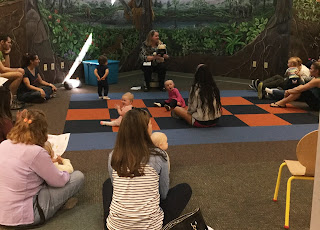
baby storytime

The regular presenter does a welcome song that calls every baby by name, but I did not think my voice was up to 25 verses, so I used a song from Jbrary instead:

Hello, Everybody

Hello, everybody! Can you touch your nose?
Touch your nose, touch your nose?
Hello, everybody, can you touch your nose?
Touch - your - nose!

(touch toes, pat head, rub tummy, etc.)

Babies love to show off their receptive language by pointing to body parts, and these songs and rhymes are not only fun, they reinforce vocabulary and body awareness. I explained as I modeled with my "baby" how parents could either model by touching their own nose, etc., touch their baby's nose, or help their baby touch their nose, depending on the age and what they were comfortable with.

I followed that with a lead-in song that the regular presenter uses that also has movements for the babies to do or parents to do with them:

Come Along and Sing With Me
(to the tune of "London Bridges")

Come along and sing with me, 
Sing with me, sing with me.
Come along and sing with me,
It's time for storytime!

(clap, wave, wiggle, bounce, play, etc.)

Then we got the big bin of balls out, with balls of various sizes, colors, and textures, for them to play with for a few minutes (with music), then I sang the "Clean Up" song while we all picked them up and put them away. 

Since they were now all hyped up, I followed this with a more active song that I also got from Jbrary that is supposed to get everyone up dancing, either picking up their child and holding them, or for the more mobile and independent one, holding their hands and dancing with them.


(To the tune of “Shortnin’ Bread”)

Mama’s little baby loves dancing, dancing;
Mama’s little baby loves turning ‘round.
Mama’s little baby loves dancing, dancing;
Mama’s little baby loves to boogie down.

Lean to the left, lean to the right;
Hug that baby nice and tight.
Lean to the left, lean to the right;
Hug that baby nice and tight.

Mama’s little baby loves dancing, dancing’
Mama’s little baby loves turning ‘round.
Mama’s little baby loves dancing, dancing;
Mama’s little baby loves to boogie down.

(Daddy, Auntie, Grandma….)

I mentioned that these bigger movements of holding them up high, down low, leaning to each side, and turning around helps develop their proprioception, or awareness of their body's position and movement in space. I personally love this movement song, but the caregivers did not really get into it like I expected.

To settle down in preparation for reading the story, we followed that with a gentle tickle used by the regular presenter, with modification:

Tickle You Here

Bounce you here, kiss you there,
Bounce you, kiss you, everywhere.

(tickle, kiss, hug)

Baby storytime

And now it was [finally] time to read our book. I choose Ten Tiny Tickles by Karen Katz, which probably would've been better for the younger "Cuddle Babies" class as it is a sweet, gentle story counting as we tickle baby, working on vocabulary as well. In retrospect, I would have been better off reading her Ten Tiny Babies, which has movements for older, more mobile babies to do, plus has more diversity. But all her books are great for babies and toddlers.

Following the story, we did a classic bounce, The Grand Old Duke of York:

The grand old Duke of York,
He had ten thousand men.
He marched them up to the top of the hill,
And he marched them down again.

And when they were up, they were up.
And when they were down, they were down.
And when they were only half-way up,
They were neither up nor down.

And then the "Five Little Ducks":

Five little ducks went out to play,
Over the hills and far away.
Mama Duck called them with a
"Quack, quack, quack,"
And four little ducks came running back.

(count down to no little ducks)

Then, Mama Duck called with a
"QUACK, QUACK, QUACK!!"
And five little ducks came running back!

We finished up by blowing bubbles with music playing in the background.


How It Went

I think it went fairly well. I was a little nervous, never having done that age group before nor having observed as many as I would like, but I didn't suck! Though I love being able to read longer books to older kids who are able to appreciate humor, I had fun with the babies, too, and found I was more comfortable slipping in development and literacy tips with this age.

Each individual part of the storytime was fine, though I did not quite get as much participation from the parents and expected interactions between caregiver and child. Most of the babies were walking, so the parents tended to let them just kind of mill around, though most of the babies did imitate many of the actions. I found that while I liked all the individual parts, I did not feel comfortable with the overall structure for a few reasons.

First, it just felt a little choppy as I quickly moved from one thing to the next, trying to get everything done in our 30 minutes time frame, and the transitions were awkward (that could just be me). I think I would have preferred to leave off a couple of the songs/rhymes, and do more verses or repetitions of the ones we did..

But the biggest thing that felt really off to me was having gross motor play in the beginning, between rounds of songs and before the story. I'm sure those that do it this way have a good reason and it works for them, but to me it just seemed like it got them wound up and left them hanging as there wasn't much time for it. Also, babies start to develop object permanence at 4 months, and it's pretty solid by a year old, so you are risking some serious meltdowns when you have to put the balls away again so soon, and I did have one. 

Personally, I would save playtime for the end, and let them have more time with them. And I would probably vary it, and have different toys or more structured play activities, depending on the ages.

If you regularly do Babytime, what is your structure? How many songs/rhymes/bounces do you do, and do yo include gross motor play in the middle or end?


Monday, April 8, 2019

Bunny Rabbits - Family Storytime


I have this really cute bunny felt set with 2 rhymes and a song to go with them, so since it was the beginning of Spring when we start to see baby bunnies appear and close to Easter I decided to do rabbits for my theme.

I started with my welcome song and introductions, and then realized I completely forgot to grab the non-fiction book I had intended to use in the introduction. I moved on to our story song and decided since it was a slightly older crowd than usual I would get to read one of the longer stories, Muncha, Muncha, Muncha by Candace Fleming and G. Brian Karas, which I love.

In this story, Mr. McGreely finally plants the garden he's always dreamed of, but just when the fruits of his labor are ready to pick, 3 hungry bunnies sneak in and eat them. He tries everything to keep them out, but they still get in every time. There is a lot of repetition, plus an increasingly angry Mr. McGreely.

After that we did a counting down rhyme with the flannel board:


Five Little Bunnies
(modified from Let's Play Music)

Five little bunnies playing on the floor;
One hopped away, and then there were four.

Four little bunnies hiding behind a tree;
One climbed up, and then there were three.

Three little bunnies wondered what to do;
One went to sleep, and then there were two.

Two little bunnies looking for some fun;
One jumped down a hole, and then there was one.

One little bunny, alone in the sun;
He hopped home to his burrow, and then there was none.

[For the pattern and more ways to use this felt set, see my "Flannel Friday Five Little Bunnies" post.]

Then we read another favorite of mine, Everybunny Dance by Ellie Sandall. I love this book because it is is so interactive and incorporates movement. The audience can stand up and pretend to be one of the bunnies and act out the motions with them as they dance and twirl, clap their paws, bang a drum, toot a horn, and sing, until the fox shows up! 

Then all the bunnies must run and hide, holding their breath and not making a sound. But as it turns out, the fox is only looking for an audience. 

Despite these books always proving to be extremely engaging in the past, I was completely loosing my audience so I decided to call it quits, and went right to our closing song, then put out the materials for the optional craft.

Craft
I actually put out two options for the craft, one was making a simple paper headband with bunny ears. I cut paper strips for the headband, and printed out sheets with the bunny ears and let them cut them out, figuring they would be easier to color that way, and maybe the kids would get some practice with scissor skills.

For the second, I borrowed a cute idea from another children's librarian who was gracious enough to share her file with me, to make a Duck-Rabbit. If you look at it one way, it's a bunny, but if you flip it over, then it's a duck! I printed it out, and provided crayons, scissors, googly eyes, and cotton balls for tails. I also used feathers last time, but opted not to this time because they are so messy and irritating. I saw one bunny leaving that must've grown up near a nuclear waste dump site, because he had about a dozen eyes all over his body, LOL! This was my example:


How It Went

I have to say, this was a very disappointing and dissatisfying storytime, despite all the components having been extremely engaging and well-received in previous storytimes. My "cute little animals" themed outreach visit last week went much better.

This is the weekend all-ages family storytime, and we (the two children's librarians and two children's associates) each do it one weekend a month. It doesn't have a regular crowd like the weekly storytimes do, so you really have a different crowd each time, and you never know what ages you'll get.

I was at first pleasantly surprised when I saw it was a slightly older crowd than usual, which usually means they are more engaged and can do longer, more sophisticated books and they pay attention and participate more. Not this time. I don't know what it is, but people here often just will not sit close enough to me to really see and hear well. I keep encouraging them to move in close, and sometimes they will, sometimes they won't. This group just wouldn't; it was like they thought I had some terrible contagious disease. I even had one family sit behind me!

No matter how hard I tried, I just couldn't keep them engaged, and there was too much chatting amongst themselves by both parents and kids, distractions from other stuff going on, and the parents weren't really doing anything to help keep the kids focused. I really though I'd have a lot of fun with this storytime, and ended up cutting it short instead. I find I'm enjoying my outreach visit more than this in-library storytime much of the time, but there are still days when I get a good group and it goes really well. 

Monday, April 1, 2019

Cute Little Animals - Outreach Storytime


Today was my monthly outreach visit to a nearby daycare, and with it being Spring (finally), I decided to do stories with cute, fluffy animals. I see ages 1 through 4 years old, so I need a range of books, and I start with mostly songs for the youngest, then end with mostly books for the oldest. Since I only have 20 minutes per group, I do an abbreviated storytime and start with a shorter "Hello" song than my usual opening song.

1-Year Olds 
The babies still do best with songs, so after the "Hello" song, we did "Itsy Bitsy Spider" twice, then "The Wheels On The Bus", and "Little Bunny Foo Foo". Then I read Mary Murphy's Say Hello Like This. This book is short and sweet, and features animals and their sounds, which little ones usually like and it's good for phonological awareness. I also like the bold, simple illustrations with heavy outlines for the younger kids, since simple, high contrast images are known to hold their interest. We finished with our "Storytime Is Over" song. Though I love the babies, I couldn't wait to get out of there as they all had nasty, snotty noses!

2-Year Olds 
The 2-year olds really surprised their teachers with how well they did last time, and today they [almost] all sat down and were ready to listen almost right away. After the "Hello" song, we sang the ABC's and "The Wheels On the Bus", then I read Five Little Chicks by Nancy Tafuri, which is a short, simple story that begins with the Mama hen and five eggs, which hatch, producing five little chicks. 

The five little chicks then each start looking for something to eat and investigating different things: worms, beetles, butterflies, fish, and strawberries, then finally their mother shows them how to scratch in the dirt near the corn field to look for corn and other seeds. The kids can identify each potential food, and comment on whether they would like to eat it or not.

After that we stood up for a very fun and interactive book, Ellie Sandall's Everybunny Dance! This is a great movement book, as the kids get to pretend to be bunnies and act out the story, dancing, pretending to play instruments, and singing, until the fox comes out and they run and hide! But, as it turns out, the fox only wants an audience. Sometimes I follow this by doing the "Bunny Hop" conga dance, but I thought these kids were too young to follow the steps.

3- & 4-Year Olds 
Today they were expecting me, fortunately, so I didn't have to wait very long for them to sit in the story area and get settled. I started with the "Hello" song, then my "If You're Ready for a Story" song. I had planned to do Everybunny Dance! with them as well, but the space was just too cramped, so I had to change my plans. Instead, I read Wee Little Bunny by Lauren Thompson and John Butler, which was probably a little on the simple side for this age, but they were okay with it. The story shows a new little bunny as he plays and frolics, meeting a new friend along the way, then goes home at the end of the day and tells his mother all about his busy day.

Then I asked the kids if they knew what today was. They knew it was the first day of April, but didn't know about April Fool's Day. So I explained that it was a day people played silly little tricks on each other, just like we would see in our story, Barnyard Fun by Maureen Wright. I was SO excited when I found this book! It is the only April Fool's Day book I have found that is suitable for storytime. It is April 1st, and Sheep has a bunch of barnyard pranks to pull on his friends. He sets Rooster's alarm an a hour earlier, replaces Dog's can of food with a can of springy "snakes", serves Pig a "cake" that is just box covered in icing, and connects Cow's dots to make smiley faces. Then Horse decides to give Sheep a taste of his own medicine, with hilarious results!

I concluded with showing them my April Fool's joke, a nice pan of "brownies".


How It Went 
This was my third visit to the daycare, and the kids seem to be remember me and are getting used to the routine, so it is going more smoothly each time (not that it's ever gone badly). Today I was greeted by lots of smiles and "Hi!"s, and even a couple of hugs.

Everything worked really well, and I was glad to have the chance to read Barnyard Fun for April Fool's again, and share my little prank. They all laughed and thought it was hilarious when the other animals gave Sheep a taste of his own medicine by shearing him to look like a poodle!

Wednesday, March 27, 2019

Moon Madness - STEAM Program


Moon STEM program


So far this year I've done topics related to physics, chemistry, geology, engineering, and microbiology, so I decided it was time to do something from the field of astronomy. I chose to focus on the moon, and doing activities to learn about how craters are formed, solar and lunar eclipses, and the phases of the moon.

I put together a few slides in a PowerPoint presentation, showing close-up pictures of the moon with the craters clearly showing in relief and a picture of the earth taken from the moon. We talked a little about the moon, and how it goes around the earth, asked them what they noticed about the photos. We discussed the craters, how they might be formed, and why we don't see them in pictures of the earth. Then we did an activity to simulate how craters are formed.

After that, I showed pictures from a solar eclipse, and a diagram illustrating what is happening, and the same for a lunar eclipse, and talked about when the next of each would be seen in our area (April 8, 2024, and May 15/16, 2022, respectively). Then we talked about the phases of the moon. Afterward, we did activities to simulate a solar eclipse, a lunar eclipse, and the phases of the moon. I also had both non-fiction and fiction books about the moon on display for them to look at and checkout.


Moon STEAM program

Materials: 

  • salt dough, play dough, or clay
  • styrofoam circle carved to convex shape, optional
  • balls of various sizes
  • lamp with shade removed and 40W spherical bulb
  • 3-4" styrofoam ball, covered with aluminum foil
  • sharpened pencil
  • paper plates
  • Oreo cookies (or generic equivalent), 8/participant
  • vanilla icing
  • snack-sized baggies
  • plastic knives
  • pens
Activity #1 - Crater Formation Simulation 

1. I had a 14" styrofoam cake dummy leftover from my wedding cake business from years ago, so I carved the sides down to round them off into a convex shape.

2. I had some of the early arrivals help me cover the styrofoam form with salt dough that I had colored gray, then propped it up on a table, against the wall.

3. Then everyone took 2-3 turns throwing different balls at it, to simulate meteors hitting the surface of the moon.

Activity #2 - Solar and Lunar Eclipse Simulation 

1. I set up a lamp with a 40W spherical bulb to represent the sun (a regular bulb is fine, too), and covered a 3" styrofoam ball with aluminum foil to represent the moon, and stuck a sharpened pencil in it to make a convenient handle. I asked the kids to guess what each represented, and of course they did, then told them that they would represent the earth.

2. I first turned the light off, and demonstrated how to stand in front of the "sun", and gradually move the "moon" until in between their head and the sun, creating a total solar eclipse, then continue until the eclipse was over. 

3. Then I demonstrated how to move through the waxing phases of the moon, until they were in full moon, which would be eclipsed if they held it directly in line with the "earth" and the "sun", then move through the waning phases.

4. I had two stations set up, and then let them takes turns trying it out themselves. (The eclipses are more obvious that the phases with this activity.) The video below demonstrates the phases:


Activity #3 - Edible Phases of the Moon 

1. I pulled up the slide showing all the phases of the moon, and briefly reviewed it, then handed out the supplies: paper plates, cookies, plastic knives, and small zip-lock bags with a little icing in them and the corner snipped off.

2. Then I showed an example of how the cookies could be used to demonstrate the phases of the moon by carefully twisting off the tops and using the knives to remove and shape the filling to look like the different phases. The bags of icing were to be used to "glue" the cookies to their plates.

3. Then they were to use a pen to label each phase and add arrows showing the order.

4. I told them they could eat the tops and discarded filling now (if it was ok with their grownup), but to take the finished project home and eat later, whenever their grownup said it was okay.


kids' STEM/STEAM moon program, kids' activities to learn about the moon

How It Went 

I had a good turnout of 13 kids and 7 adults, and the kids seemed to enjoy it, but I was not really happy with it. I felt like I ended up doing too much "lecturing" and not enough hands-on. I struggle with finding good hands-on activities for space-related themes, other than those that are more engineering, focusing on the rockets and rovers used to explore space.

The crater simulation did not work as well as I'd hoped. The balls were not hard enough and the kids could not throw hard enough (or with enough accuracy, even from very close!) to make anything more than slight dents, rather than more dramatic craters like I'd hoped. In retrospect, I wish I'd thought to just have them come up and just hold onto the balls and hit it, or just use their fists. I've also seen this done with shaving cream or paint spread in a circle, which might work better, but would also be much more messy.

Using the lamp and props to simulate eclipses worked really well, but the kids did not seem that interested in it. Seeing the phases of the moon was much more subtle with this activity, and most of them did not have the patience or perception to really see it.

They were all excited about getting cookies, but some did not have the patience to complete the activity and do it correctly, and I had a couple of parents that were completely checked out and not doing the activity with their children as they are intended to with this age group.(I also had 1 package of cookies that were gluten free.)

I'm always disappointed with how few of the books I pull related to the theme get checked out. 

What I'd Do Differently 

As mentioned already, I'd try having much heavier balls or rocks even, and instead of throwing horizontally at a vertical target, I'd just put the target on the floor and have them drop them on it, or just hold onto them and hit it. The salt dough did make a nice moon-looking surface, though.

I was not happy with how the other two activities went, though the kids were happy to get cookies, and I don't think I'd use them again, but I'm not sure what I'd do instead.

I think the biggest thing I would do differently, is just not do the theme. I've realized it's better just to skip it if I'm not thrilled with how well it lends itself to hands-on activities, or activities I like, than to force it just because we haven't covered it. Some things are just better suited to this age level (supposed to be 5-10, but the reality is mostly 5-6-7, and usually at least one younger sibling) than others.

Then with the continuing issue of parents not participating or adequately supervising, I've got to remember to make my spiel about expectations and safety every time!

If you've done this theme with greater success, I'd love to hear about what activities you used!

Tuesday, March 19, 2019

Picture Book Review - The Very Impatient Caterpillar


I have not seen very many picture books in the last year that I really liked, and even fewer that I was excited about using in storytime. I loved Stuff of Stars and Dreamers that came out in the fall, but they aren't really storytime books. I did find Misunderstood Shark and its brand new sequel very funny and full of the dark humor I love, plus interesting facts, but they are better for an older audience than I currently see.

But this week I was excited to finally come across a new picture book that I liked, and could see using with the kids I have now! We all know Eric Carle's The Very Hungry Caterpillar, which is celebrating its 50th anniversary this year, but now meet another caterpillar:


Review of The Very Impatient Caterpillar by Ross Burach
The VERY Impatient Caterpillar 
Written & illustrated by Ross Burach
February 26, 2019
Scholastic Press

This book is so funny and entertaining, with a theme everyone can relate to, being impatient.

One caterpillar sees all the other caterpillars scurrying up the tree and wants to know what is going on. One responds that they are going to metamorphosize. "Meta-WHAT-now?" he exclaims. At first he can't believe he can really turn into a butterfly, but he follows and does what everyone else does.

However, he finds that waiting to become a butterfly is a slow process, and two weeks seems like forever. He keeps asking if he's a butterfly yet, tries to occupy himself, but he can't stand it.


Review of The Very Impatient Caterpillar by Ross Burach

After emerging early only to find he is most definitely not a butterfly yet, he finally settles down and uses breathing techniques to relax and go to sleep, while mother nature does her thing. He emerges as a beautiful butterfly, and has learned a valuable lesson in patience.


Review of The Very Impatient Caterpillar by Ross Burach


Or has he?


I think older kids and adults will more fully appreciate the humor, but I think it is basic enough that even the younger kids will find it funny as well. I like the short, simple text and the bold, bright illustrations that aren't too busy and are very expressive. The middle seems to go on just a teeny bit too long, so if you have a younger audience, you might want to skip a couple of pages, or some of the dialog. The text is all dialog in the form of speech bubbles, and fans of Mo Willem's Pigeon and Elephant & Piggie books are sure to like this one!

I do love that it uses the correct word, chrysalis rather than cocoon (moths come out of cocoons, not butterflies), and contains the word "metamorphosize" to get in some great vocabulary. Besides being funny, it can lead to learning more factual information about caterpillars and butterflies, other animals that undergo metamorphosis (like tadpoles to frogs), and/or talking about learning to be patient and coping techniques to help us be patient.

I really liked this one and can't wait to use it in a "Bug" or "Butterfly" themed storytime soon, and I think I'll have to give his Truck Full of Ducks another look!

Saturday, March 9, 2019

Lions, Tigers, & Bears 2019 - Family Storytime


I first did this theme about 3 years ago, after seeing someone else mention it and thinking it would be fun (and it was!). I thought it would be perfect for the younger crowd I get for this weekend family storytime as it embraces their natural inclination to be wiggly and noisy, rather than fighting it, and I was able to find a great new set of books to use for it.

We started with our welcome song and introduction. I asked if anyone knew what movie the line "lions, tigers, and bears; oh my!" came from. None of the kids really did, but a couple of them were fed the answer by their parents (The Wizard of Oz, if you didn't know). Then we talked about how to distinguish lions and tigers, and some different types of bears. 

Lions, tigers, and bears storytimer
Then we sang our story song to get settled for our first book, Don't Wake Up the Tiger! by Britta Teckentrup. This is such a great book for younger, wiggly crowds! It's fairly short and simple, with bold, bright illustrations and very interactive. 

Tiger is asleep, but the other animals need to get past her with their big bunch of balloons, without waking her up. Frog has the great idea to float over her with a balloon. But the animals need the audience to help keep Tiger asleep by rubbing her nose and belly, and singing her a lullaby. At the end, it turns out it's Tiger's birthday, and we all sing her "Happy Birthday".

lions, tigers, and bears storytimeSince we sang two songs as part of the story, I asked the kids if the wanted to do a song, or go right to another book, and they wanted a story! For the second story I read our longest one, Lion Lessons by Jon Agee, which was another interactive story with lots of movement about a boy who is taking lessons on how to be a lion, from a real lion! (I should've done it first to be true to our theme, but I was hesitant since it was longer.)

There are stretches, looking fierce, roaring, sprinting, eating, hiding, and pouncing, and the boy doesn't perform to the lion's standards. But then he excels in the last test, looking out for a friend. This was a really fun book! (For a somewhat similar one, check out You Are a Lion! by Taeeun Yoo that does lots of different animal yoga poses).

Then it was time for a song where we could pretend to be lions even more!

If You're A Lion...

If you're a lion and you know it, give a ROAR!
If you're a lion and you know it, then your ROAR will surely show it.
If you're a lion and you know it, give a ROAR!

Shake your mane, show your claws, give a growl, swish your tail...

lions, tigers, and bears storytime
Then it was time for one last story, and I asked them which animal did we have left to talk about, and they quickly responded "Bears!" I chose this sweet, simple book by Nancy Tafuri that I had not seen before, Mama's Little Bears. This has sparse text and follows three little cubs as they explore their surrounds while Mama fishes a little while longer. 

This is great for positional prepositions as they look over, under, in, up, and down and discover blueberries, birds, salamanders, mice, otters, and owls (all mothers with young as well). In the end they call for Mama, and she finds them and they give each other big bear hugs, which prompts all the caregivers to give their little ones hugs as well.

We followed with a song that included all 3 animals:

You Can Hear...
(to the tune of "She'll Be Comin' 'Round the Mountain")

You can hear lions roaring at the zoo...ROAR, ROAR
You can hear lions roaring, you can hear lions roaring,
You can hear lions roaring at the zoo...ROAR, ROAR

tigers growling.....bears snoring....

And then sang our closing song and brought out the optional craft.

Craft
Since we get such a young crowd, I try to keep the crafts as simple as possible. I saw a picture on Pinterest of a simple "mask" to resemble a bear, made from a paper plate with the center cut out for the child's face to peek through. I decided to that, but provide materials and examples for all three options.

I cut out the plates, sorted out crayons in shades of yellow, orange, brown, and black; provided scrap paper in brown, yellow, and orange for cutting out ears, and curved pieces of brown for lion manes, plus craft stick handles, scissors, and tape.

Lion, tiger, or bear cutout mask craft

How It Went
I had a decent turnout today, with about 10 kids, mostly age 2-4, with a couple just under 2 and one older sibling around 6-8, and we had a lot of fun. The kids really enjoyed the theme and getting to participate with the story in Don't Wake Up The Tiger! and acting like lions and other animals with Lion Lessons and the songs. They did a great job identifying the animals in Mama's Little Bears, but were stumped by the otters.

I think I got the most participation and answering of question by the children today, as compared to any other of these weekend family storytimes I've done. Two or three of them couldn't stay sitting and often wondered around or up close to me, and I told their parents that they were fine and we don't expect the little ones to sit still and be quiet, and they often are listening better and absorb more than we think.

As usual, several skipped the craft, but the ones that did it seemed to really get into it, adding additional details like whiskers. All in all, it was a really great storytime!

Monday, March 4, 2019

Dr. Seuss On The Loose 2019 - Outreach Storytime


I thought I had done my previous Dr. Seuss-themed storytime last year, but as it turns out it's already been 2 years! I had an outreach visit today, and since it was just two days after Dr. Seuss's birthday, I decided to go ahead with that theme.

I would be seeing ages 1 through 5 on this visit, so I had to plan a wide range to be sure I had stuff that would work for the age of each group. I took several books, but ended up only actually using two, Mr. Brown Can Moo and Because a Little Bug Went Ka-Choo! Both were written by Ted Geisel, but only the first was published under the "Dr. Seuss" name, while the second was a collaboration with another writer friend and published under the name "Rosetta Stone".

I also had two special songs prepared:


Dr. Seuss Is On the Loose
(to the tune of "BINGO")

Dr. Seuss is on the loose,
and this is how we know it.
Cats, hats, eggs, and ham,
Cats, hats, eggs and ham,
Cats, hats, eggs, and ham,
This is how we know it.

Dr. Seuss is on the loose,
and this is how we know it.
Grinch, Sneetches, Turtles, and Wockets,
This is how we know it.

Dr. Seuss is on the loose,
and this is how we know it.
The Lorax, Things, Fish, and Whos,
This is how we know it!

Dr. Seuss is on the loose,
and this is how er know it.
Cats, hats, eggs and ham;
Grinch, Sneetches, Turtles, and Wockets;
The Lorax, Things, Fish, and Whos;
This is how we know it!

And I had these little stick puppets to go with it:


Green Eggs and Ham
(to the tune of" London Bridge")

I don't like green eggs and ham,
eggs and ham, eggs and ham.
I don't like green eggs and ham,
Sam-I-Am.

Would you like them here or there,
here or there, here or there?
Would you like them anywhere? 
Green Eggs and Ham.

I don't like them here or there,
here or there, here or there.
I don't like them anywhere,
Sam-I-Am!

You should try green eggs and ham,
eggs and ham, eggs and ham.
You should try green eggs and ham,
You might like them!

I do! I like green eggs and ham,
Eggs and ham, eggs and ham,
I do! I like eggs and ham,
Sam-I-Am!

These were short 15-20 minute sessions each, due to time constraints, though I prefer to do 30 minutes for preschool and up. I used a very short "Hello" and "Goodbye" song, and only read 1 book and did several songs for each.

1-Year Olds 
Dr. Seuss storytime
For the 1-year olds, I started off with a couple of familiar childhood songs, "Itsy Bitsy Spider" and "Twinkle Little Star", then did one verse of our story song before reading Mr. Brown Can Moo, Can You? because it is very short and sweet, and I knew that the kids would like identifying the animals and making their sounds. I followed that with "Dr. Seuss Is On the Loose" and the "ABC song" before closing. 

2-Year Olds
I did the same thing with the 2-year olds, accept I did the "Green Eggs and Ham" song instead of "Twinkle Little Star".

3 & 4-Year Olds
Dr. Seuss storytimeWith this group I did the "Hello" song, and "Dr. Seuss Is On The Loose", then the story song. I read the longer Because a Little Bug Went Ka-Choo! to this group, than sang the "Green Eggs and Ham" song, followed by the "Good-bye Song".

How It Went
It went pretty well considering this was only my second visit (and only my second time doing storytime with 1 & 2 year olds), and because of time constraints we had to combine two 2-year old classes (much to the dismay of the teachers) and the 3- and 4-year old classes.

The babies were so cute, except for the 3 that were obviously sick and not feeling well and should have been at home. One little guy looked up when I came in and gave me a huge smile and very enthusiastic "Hi!". He is so friendly and happy and adorable, I just wanted to squeeze him (I didn't). Not all participated, but most still seemed to enjoy it, and I love seeing them.

Despite the teachers' predictions of disaster, the combined 2-year old classes did just fine. While there were a few that wandered around the periphery, most actually sat and participated and listened for most of the time, and had a great time. They'd had enough after 15-20 minutes, but they're TWO! I was perfectly happy with how it went.

I enjoyed getting a chance to read a longer story with the older kids, and they were much more familiar with Dr. Seuss, his books, and his characters than the others, so it was more fun and meaningful for them. One boy didn't appreciate the "Green Eggs and Ham" song and asked if we couldn't just read it instead, LOL! Several of them said they had seen me at the library before. I'm so glad I'm getting to do a little outreach! It just has a different vibe and I've really missed it. I'm just going to have to convince them to let me stretch it out just a few more minutes for the older kids...